
⚠️ Visitors to our site are often searching for information because they, their best friend, or a family member has unfortunately fallen into use of dangerous substances. We aim to provide educational information, but more importantly, we protect people from the dangers of all forms of substance abuse! ⚠️
Call our admissions department at (855) 855-6544 or verify your insurance here to get immediate substance abuse help for yourself or a loved one.
Alcohol usually stays in your blood for up to 12 hours, but tests that look for alcohol byproducts can find it much longer, from several days in urine to weeks in blood, and over longer periods in hair. [1][4]
The exact timing depends on how much you drank, how fast, and which test is used, since some tests look for alcohol itself while others look for what’s left after your body breaks it down.
In this article, we’ll break down detection times by test, what changes how fast alcohol leaves your body, and what it might mean if you’re worried about passing a test.
Key Takeaways
- A standard blood alcohol (BAC) test shows alcohol for up to 12 hours after drinking. [1]
- Urine EtG tests can detect drinking for about 1 to 5 days, depending on how much was consumed. [3][4]
- Other blood tests, like PEth, can show drinking from the past days to weeks. [1][5]
- Hair tests can show alcohol use over long periods. [6]
- Blood alcohol usually drops by about 10 to 20 mg/100 mL per hour, so 0.08% takes roughly 4 to 8 hours to clear. [2]
- Coffee, cold showers, and walking don’t reverse the effects of too much alcohol. [8]
- If counting hours before a test is becoming routine, it may be time to talk to someone.
How Long Is Alcohol Detectable by Each Test?
Alcohol is detectable for anywhere from a few hours to weeks, depending on the test. A standard blood alcohol (BAC) test shows alcohol for up to 12 hours after drinking, while other blood tests can pick up alcohol byproducts for weeks, according to MedlinePlus from the National Library of Medicine. [1]
| Test | What It Looks For | Typical Detection Window |
| Breath (breathalyzer) | Alcohol in your breath | Only while alcohol is still in your bloodstream [1][2] |
| Blood (BAC) | Alcohol itself | Up to 12 hours [1] |
| Urine (EtG) | Ethyl glucuronide, an alcohol byproduct | About 1 to 5 days, depending on how much was consumed [3][4] |
| Blood (PEth and similar) | Phosphatidylethanol, an alcohol byproduct | Days to weeks [1][5] |
| Hair (EtG) | Alcohol byproducts stored in hair | Longer periods, depending on hair length [1][6] |
| Saliva | Alcohol itself | Recent drinking [1] |
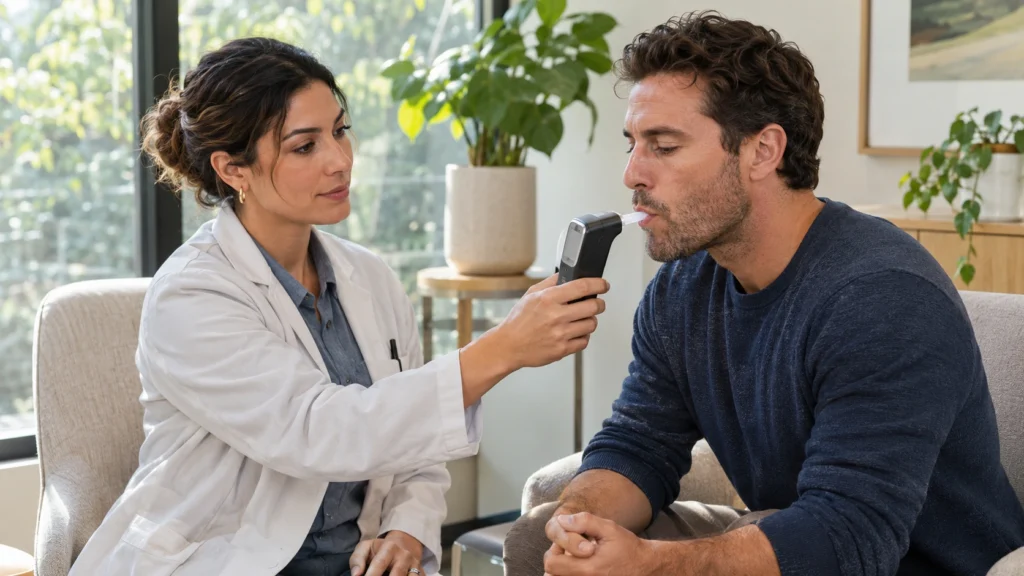
How Long Can a Breathalyzer Detect Alcohol?
A breathalyzer checks your breath for alcohol, which makes it a quick way to estimate how much is in your blood. [1] As a result, it can only find alcohol while your body is still clearing it.
How Long Does Alcohol Show Up in Blood?
The standard BAC test shows alcohol in your blood for up to 12 hours after drinking. [1] However, other blood tests, such as PEth, can show drinking from the past days to weeks, which is why they’re often used to check whether someone has stayed sober. [1][5]
How Long Is Alcohol Detectable in Urine?
Urine tests usually look for ethyl glucuronide (EtG), a byproduct that stays around after the alcohol itself is gone. In heavy drinkers going through detox, EtG stayed detectable for about 40 to 130 hours, with a median of 78 hours. [4]
After lighter drinking, though, the window can be much shorter, as one study found that commercial EtG tests missed every sample collected more than 26 hours after drinking. [3]
How Far Back Can a Hair Test Go?
Hair testing for EtG can detect alcohol use over long periods, even after alcohol has completely left the body. Results can be affected by hair length, cosmetic treatments, and other factors. [6]
How Long Does It Take Your Body to Clear Alcohol?
Your body clears alcohol at a fairly steady pace, mostly through the liver. On an empty stomach, blood alcohol usually drops by about 10 to 15 mg/100 mL per hour, and after eating, it tends to drop by about 15 to 20 mg/100 mL per hour. [2]
So if someone reaches the common legal driving limit of 0.08% (80 mg/100 mL), it would take roughly 4 to 8 hours at those rates for their blood alcohol to reach zero. [1][2]
Keep in mind that your liver can only process small amounts of alcohol at a time. [7] If you drink faster than it can keep up, your blood alcohol level keeps rising. [1]
Also, a “drink” may be more than you think, because in the U.S. one standard drink is 12 ounces of 5% beer, 5 ounces of 12% wine, or 1.5 ounces of 80-proof liquor. [7]
What Changes How Fast Alcohol Leaves Your Body?
The biggest factors are how much you drink, how quickly you drink it, and whether you’ve eaten. Eating before or while drinking is linked with a faster elimination rate, while drinking a lot in a short time pushes blood alcohol higher than the liver can handle. [1][2]
Heavy, long-term drinking can change things too. In people with alcohol dependence going through detox, the body may clear alcohol faster, about 25 to 35 mg/100 mL per hour, because certain liver enzymes become more active. [2]
On the other hand, coffee, cold showers, and walking don’t reverse the effects of too much alcohol, and they can actually make things worse. [8]
Read More: How To Sober Up Quickly From Alcohol
When Is Too Much Alcohol in Your System an Emergency?
Too much alcohol becomes an emergency when someone shows signs of an alcohol overdose, such as confusion, trouble staying conscious, vomiting, seizures, slow or irregular breathing, clammy skin, or very low body temperature. If you see these signs, call 911 right away. [8]
Don’t assume someone who has passed out will be fine after sleeping it off, because blood alcohol can keep rising even after a person stops drinking or is unconscious. [8]
Mixing alcohol with opioids or with sleep or anxiety medications, such as benzodiazepines, can also raise the risk of an overdose. [8]
Read More: Mixing Xanax and Alcohol: Why This Combination Is More Dangerous Than You Think
What if You’re Worried About How Much Alcohol Is in Your System?
If you often find yourself counting hours before a test, a shift at work, or a drive, that can be a sign your drinking is starting to run your schedule. It’s worth taking an honest look at, especially if you’ve tried to cut back and it hasn’t stuck.
If you’re thinking about cutting back after a long stretch of heavy drinking, it’s safer to talk with a professional first.
Read More: Alcohol Detox Timeline: What Happens After Your Last Drink
How Spark To Recovery Can Help You With Alcohol Use

Wondering how long alcohol stays in your system doesn’t automatically mean you have a drinking problem. But if drinking keeps coming back, it’s getting harder to cut down, or it’s affecting your work, health, or relationships, an assessment can help you understand where you stand.
Spark To Recovery offers Alcoholism Treatment in Los Angeles, including an Alcohol Detox Program and Residential Treatment in Sherman Oaks. You can take the next step through Admissions or check your coverage with Insurance Verification.
Medical disclaimer: This article is for educational purposes and doesn’t replace medical advice. If someone is in immediate danger, call 911, and for suicidal thoughts, call or text 988.
Why Inpatient Medically Assisted Rehab Is the Best Solution

Inpatient medically assisted rehab makes the most sense when drinking has become daily or heavy, when withdrawal is a concern, or when it comes with anxiety, depression, or repeated relapse. A Medically-Assisted Detox Program with 24/7 medical care keeps withdrawal safer, while therapy works on triggers, coping skills, and relapse prevention.
Frequently Asked Questions
EtG urine tests can detect drinking for about 1 to 5 days, depending on the amount. [3][4]
A standard BAC test shows alcohol for up to 12 hours. [1]
Yes, eating is linked with a faster elimination rate than an empty stomach. [2]
No, a blood test gives a more accurate BAC reading. [1]
Yes, hair EtG tests can detect alcohol use over long periods. [6]

Laura A. Fierro, Ph.D., LMFT
Board-Certified Physician in Internal Medicine
Medical Sources
- Blood Alcohol Level: MedlinePlus Medical Test | National Library of Medicine
- Evidence-based survey of the elimination rates of ethanol from blood with applications in forensic casework | Forensic Science International, 2010
- Sensitivity of commercial ethyl glucuronide (ETG) testing in screening for alcohol abstinence | Alcohol and Alcoholism, 2007
- Detection times for urinary ethyl glucuronide and ethyl sulfate in heavy drinkers during alcohol detoxification | Alcohol and Alcoholism, 2009
- Detection of phosphatidylethanol after ethanol intake with targeted blood alcohol concentrations of 0.6 g/kg and 0.75 g/kg | International Journal of Legal Medicine, 2025
- Hair ethyl glucuronide levels as a marker for alcohol use and abuse: a review of the current state of the art | Drug and Alcohol Dependence, 2014
- About Standard Drink Sizes | Alcohol Use | CDC
- Understanding the Dangers of Alcohol Overdose | National Institute on Alcohol Abuse and Alcoholism (NIAAA)